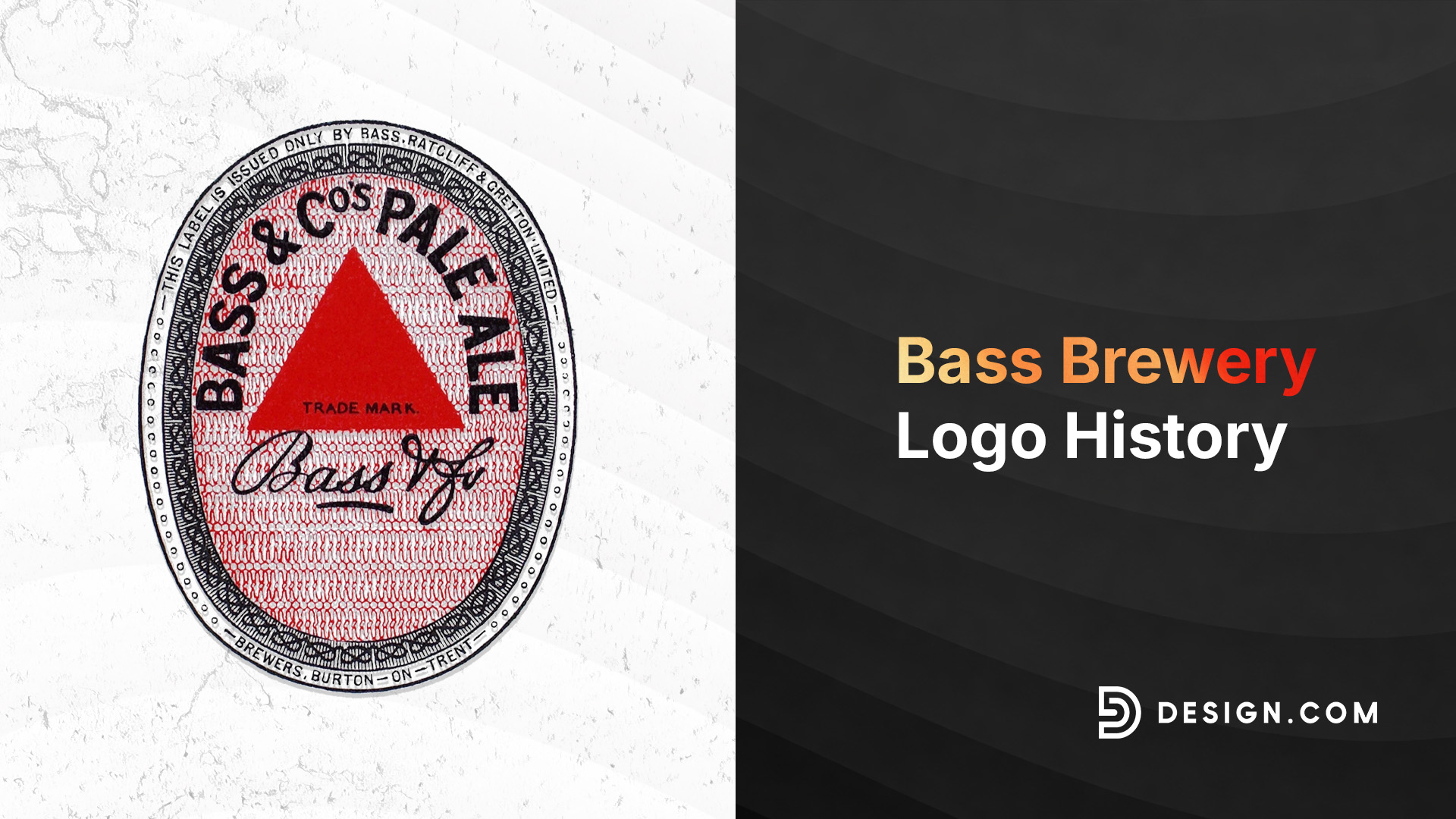
Bass Brewery Logo History: Is it the World’s First Logo?
Logos may seem like nothing more than an aesthetic choice or a simple brand mark that you see on your items. But some logo designs are so influential that they revolutionize design trends and history.
Apple started the minimalist tech branding wave. Google popularized the concept of the ever-changing logo, one that reflects major events or seasons. Nike proved that a simple symbol is enough to make them recognizable, no brand names needed. Quaker Oats started the trend of having mascots as a brand’s main logo. And Starbucks made mermaids cool (we joke!).
But before any of these famous brands existed, one brewery created a symbol that changed branding and logo use forever.
In this article, we’ll explore how the Bass red triangle became one of the most important symbols in trademark history, why its design worked so effectively, and what modern brands can still learn from it nearly 150 years later.
Bass Brewery logo history
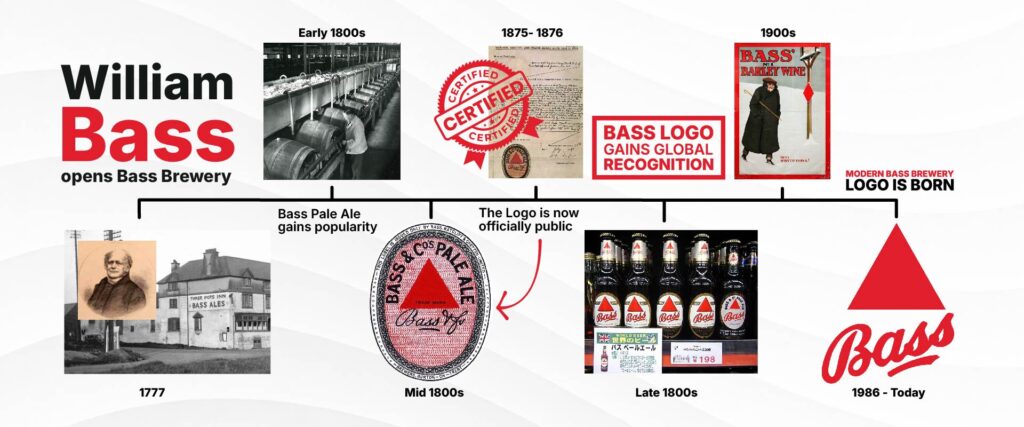
Bass Brewery was founded in 1777 by William Bass in Burton-upon-Trent, England. They were one of the first breweries in the town. However, it didn’t take long for them to make their mark, as their high-quality products and attention to branding eventually turned their Bass Pale Ale into the highest-selling beer in the UK and Bass Brewery itself into one of the largest breweries in the world.
When they were expanding during the 1800s, Bass used different triangle symbols to identify products from its various breweries and operations. These included red, white, and blue triangle marks, which helped distinguish their different beers and brewing sources.
Among these symbols, the red triangle logo became the most recognizable. Bass consistently placed the red triangle on bottles of Bass Pale Ale (their best-selling product), labels, casks, advertisements, and pub signage, making it easy for customers to identify the product from a distance.
This was a great strategic move for them, as this was during the time most consumers could not read or write, so having a simple, bold red symbol acted as a powerful visual shortcut for quality and familiarity.
The Bass red triangle had already become strongly associated with the brewery’s identity by the mid-1800s. However, the logo’s popularity, combined with the breweries’ success, also means there are a lot of copycats who want to take advantage of it.
It was said that Bass Breweries found over 2000 imitators who copied their logo, labels, or just the general shape of their icon and placed it on the beer they were exporting. One even called themselves Baass & Co. They used to relentlessly pursue these imitators in court or post about it in the newspaper, but they had no means of legal action at the time, so nothing really happened.
Luckily for them, Britain introduced the Trade Marks Registration Act in 1875, finally creating an official system for companies to legally protect their trademarks.
Bass Brewery then moved quickly to secure ownership of its most valuable visual asset. And by quickly, we mean really quickly. It was said that one of their employees waited overnight outside the registrar’s office in order to be the first in line to file the trademark the next morning. Talk about dedication!

This then led to the Bass red triangle logo being officially registered as UK Trade Mark No. 1, making it widely recognized as the world’s first registered trademark logo or the first registered trademark in the UK.
Bass also secured Trade Marks No. 2 and No. 3 for its other triangle symbols, but the red triangle became the most famous because of its strong public recognition and widespread use.
As Bass Pale Ale spread internationally throughout the late 1800s, the red triangle became one of the world’s earliest globally recognized brand symbols.
Throughout the 1900s, the logo continued appearing in advertisements, pub culture, and even famous artworks like Édouard Manet’s A Bar at the Folies-Bergère.
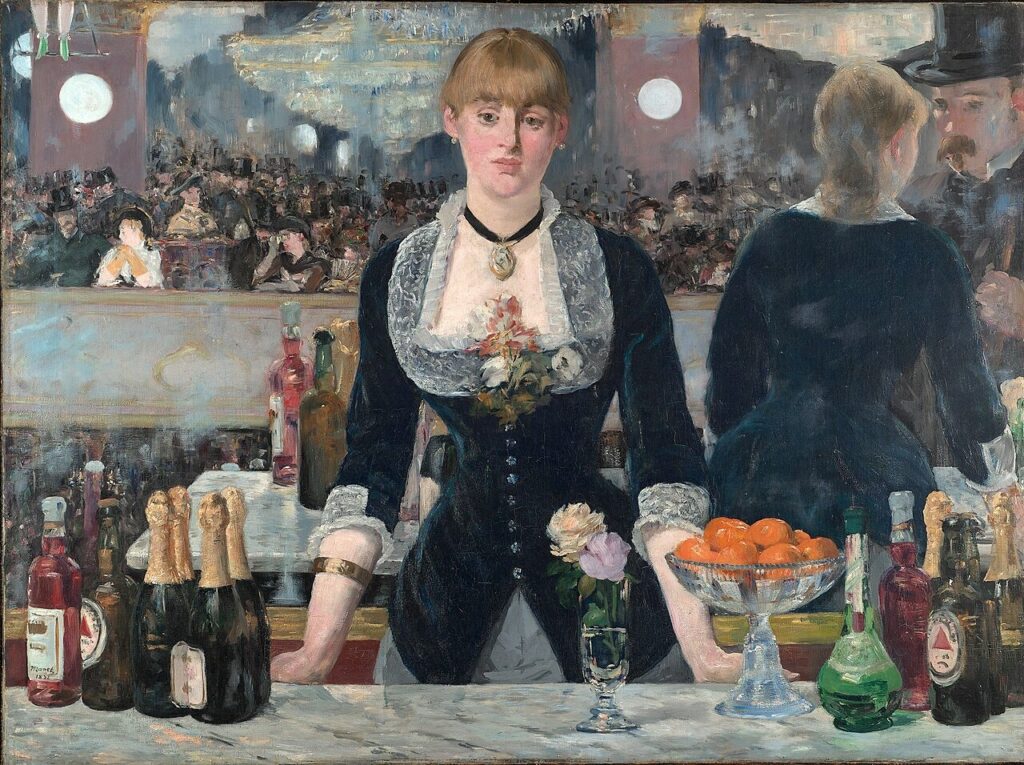
And that’s how a simple red triangle evolved from a simple label to a symbol that started heritage branding as we know it.
The Bass red triangle logo (and why it worked so well)

The most famous element in the Bass logo history is the red triangle.
At first glance, the logo may seem like it’s just a simple brandmark. It’s literally just a red triangle, with minimal details.
But that simplicity became its greatest strength.
For one, it’s easy to remember. Because the more detailed your logo is, the harder it is for your brain to visualize. But if you just need to remember one simple shape, it is easier to retain and recall.
The bold red color also means customers could quickly identify Bass products from a distance, even in crowded taverns or busy shipping docks.
The Bass red triangle also appeared prominently on beer bottles, casks, labels, posters, and pub signage. The consistent usage of it means their customers have a lot of chances to encounter the logo. This causes easy brand recognition down the line.
So to summarize, the reason why the logo is so successful is because it’s:
- Easy to remember
- Bold and distinctive
- Consistently used across all packaging to encourage brand recall
Many designers of today still follow these same principles when making a business logo or developing a modern brand identity. And it’s still successful, especially if you look at iconic logos like Nike or Apple.
The importance of trademark history in branding
The downside of the simplicity of the Bass red triangle means that it’s also incredibly easy to reproduce. This means competitors and copycats can easily copy the logo and place them on their products to confuse their customers and bait them into buying beer they assumed to be from Bass Brewery.
And this issue is not just limited to them. Any business that was successful enough back then attracted tons of imitators.
To address this issue, Britain passed the Trade Marks Registration Act 1875, creating an official system for trademark registration.
This gave Bass Brewery and other businesses:
- Legal ownership of its visual identity
- Protection against imitation
- Stronger customer trust
- Clear product differentiation
And till today, trademarks remain a fundamental part of brand strategy for businesses large and small.
Trademarks are also not just limited to logos or symbols. Names, colors, terms, or even questionable resemblance can be contested in court.
This is why you get cases between Kylie Jenner and Kylie Minogue fighting over the name “Kylie”, Nestle blocking Cadbury from trademarking their iconic Pantone 2685C purple color, and Adidas preventing Forever21 from using three stripes on their clothing products.
All of these are done to protect your brand from any financial losses to your competitors and any damage to your public image.
Common misconceptions in the Bass Brewery logo history
One common mistake when retelling Bass Brewery’s great tale is that people often call it the “world’s first logo”.
This is not correct. Bass was not the first business to use a visual symbol or identifying mark in logo history.
Long before Bass:
- Merchants used seals
- Craftsmen used maker’s marks
- Governments used coats of arms
- Businesses in general used symbols and icons as their unofficial logos
What made Bass historically important was that its red triangle became the first logo to be trademarked. So the more accurate phrase is “the world’s first registered trademark logo” or “the first registered trademark in the UK.”
Branding lessons modern businesses can learn from Bass Brewery
The Bass red triangle logo may be more than 150 years old now but the concept behind their logo still applies today. Let’s take a look at some key lessons that you could take from their story:
- Simple logos can be powerful
Many modern businesses overcomplicate their logos. They think that the fancier or more detailed it is, the better.
Bass Brewery however proved that simple is best. The red triangle was not detailed or complicated. It was literally a basic geometric shape with a bold color.
But that also means that people could recognize instantly. This mattered especially in the 1800s, when products were often sold in crowded pubs, warehouses, and shipping ports. Customers needed a fast way to identify products without carefully reading labels. The red triangle stood out immediately, even from a distance.
Modern brands still follow this principle. Some of the world’s most successful logos like Nike, Apple, Target, and McDonald’s rely on simple forms that are easy to recognize in seconds.
- Distinctive brand assets matter
Bass Brewery did not just create a logo – it created a distinctive visual asset. The asset served as a visual cue to the brain to remember Bass Brewery. So whenever people see a triangle or that specific shade of red, Bass Brewery would instantly come to mind.
This concept still exists today. Some examples are:
- Coca-Cola font
- Tiffany blue
- McDonald’s golden arches
- Nike’s swoosh
- Google color scheme
- Spotify green
This just shows that you need to think of your branding as a whole and think carefully about what can make you distinctive. Don’t just make a logo because you have to. Because as you can see from these major brands, these assets helped them be more identifiable and recognizable.
- Consistency is key
Consistency is one of the most overlooked elements of branding today. Many businesses frequently redesign logos, change colors, or shift brand styles too quickly, making it harder for customers to build long-term recognition.
Bass Brewery however had the red triangle right from the start. It was present in their vintage logo in the 1800s, and even when they modernized it in 1986. And even their 1986 logo has remained unchanged till today.
Only two logos in their long history, both containing the red triangle. It’s no wonder that they become so recognizable, since the consistent usage means people can associate the red triangle to them with no issue.
- A logo should work everywhere
The Bass red triangle worked effectively across many different formats. They had it everywhere, such as:
- Small bottle labels
- Wooden barrels
- Posters
- Pub signs
- Newspaper ads
- Shipping crates
This flexibility helped Bass Brewery maintain a consistent identity wherever customers encountered the product.
Modern businesses face similar challenges today because logos must now work across in even more formats, such as:
- Websites
- Mobile apps
- Social media
- Packaging
- Business cards
- Billboards
- Digital ads
- Merch
This shows that your logo should remain clear, high-quality, and scalable across every platform. It should remain legible whether it’s on a small website favicon or printed on huge flyers.
If you need marketing assets like these, why not check out our website builder, business card maker, and Facebook ads maker? All of these are optimized properly for size and space, so you won’t need to worry about the quality decreasing or sizing them manually.
- Legal protection is part of branding
The Bass logo history demonstrated why legal protection matters in branding.
By registering the red triangle as UK Trade Mark No. 1 in 1876, Bass protected its identity from imitation competitors. This helped customers trust that they were buying the genuine product.
Today, trademarks remain an essential part of building and protecting a successful brand. Your logo is your main identifier. Make sure you protect it.
Conclusion
The Bass Brewery logo history remains one of the most important stories in branding, trademark law, and visual identity design.
What began as a simple red triangle on beer bottles became UK Trade Mark No. 1, helping establish the modern concept of legally protected brand identity.
The Bass red triangle logo also succeeded because it was distinctive, simple, memorable, and consistently applied over time. It proves that a simple shape can create recognition faster and consistent usage of it can strengthen brand recall – all important factors to create a long-lasting brand.
We hope you enjoyed our dive into Bass Brewery’s logo history today. If it inspired you to create your own logo, feel free to hop into our beer logo maker, triangle logo maker, or red logo maker. Who knows, you just might create a great logo that will be discussed many years later, like Bass Brewery.